Here's the link to the Poemlet Blog on the Museum website.
Showing posts with label Poetry. Show all posts
Showing posts with label Poetry. Show all posts
Monday, 26 September 2016

Thursday, 25 August 2016
Weeks 31-33
The posts are getting fewer and farther between and soon this page will be archived and replaced with this one: http://juicefromspace.blogspot.co.uk That's mostly because the main thing happening at the moment is me hammering away on the keyboard and learning my lines.
In the meantime, there are a few things you should know: there's a preview of the show at the museum on Wednesday 26th October, the teacher's pack has been drafted and is ready to be reviewed by Tania, my colleague at Sustain Education, and we've a filming day with Jason booked next month to create films of two of the poems to be featured on youtube.
So here are the details of that preview - also featured on the Juice from Oranges, Rocks from Space page. Please do book as numbers are limited.
In the meantime, there are a few things you should know: there's a preview of the show at the museum on Wednesday 26th October, the teacher's pack has been drafted and is ready to be reviewed by Tania, my colleague at Sustain Education, and we've a filming day with Jason booked next month to create films of two of the poems to be featured on youtube.
So here are the details of that preview - also featured on the Juice from Oranges, Rocks from Space page. Please do book as numbers are limited.
Juice from Oranges, Rocks from Space
Wed 26 Oct
11.30am - 12.15pm & 1.30-2.15pm
A new poetry performance from Helen Clare, about exhibits from around the museum; where they came from and the journey they’ve made. There will be happy poems, sad poems, gory poems and fun poems – and opportunities for children to join in and create too.
Find out about the giant carved tusk, a moth, bloodworms, a man who was murdered and left to rot in a bog, a Greek God, Stan the T. Rex, and an ancient rock from outer space.
For children aged 8-12 and their parents/carers
Free, book on mcrmuseum.eventbrite.com or 0161 275 2648
Saturday, 18 June 2016
Week 24 and 25
 |
| Photo: Manchester Museum on flickr |
And she was right. Six of the poems fit immediately together - they are the voices of objects talking about different kinds of journeys - the Benin tusk, the Meteorite, The Death's Head Hawk Moth, Worsley Man, Hermes and the Golden Mantella Frog. Dominic also suggested that we use "Who are these souls at my breakfast table" - a poem that looks at all the people involved in making the food that we eat - as an opener.
It occured to me that all these poems answer the question "Where do you come from?" as well as "How did you get here?" Thats a good unifying principle for starters.
I have a couple more jobs, as well as a little more editing work. One is to do a mapping exercise looking at the connection between the poems. I like this sort of thing - paper, post-its and coloured pens, maybe even fancy tape, spread all over the floor.
The second job is to look for other things in the museum which haven't got poems but still have connections and form part of the narrative. Dominic suggested that the quilt with all the quotes from immigrants might have this role. The found pantoum I wrote may well be a little grown up and, as the phrases repeat with the strange claustrophobia of the pantoum, too difficult to hear.
There's also another poem on the way. On Friday I spent some time talking about buckles with Bryan Sitch the archeology curator, which was fascinating. One of the things we talked about was how ornamental and bejewelled brooches marked out people's status. He told me about sumptuary laws preventing people of lower status from wearing certain things even though they might have made the money. Here's one: "no knight under the estate of a lord, esquire or gentleman , nor any other person, shall wear any shoes or boots having spikes or points which exceed the length of two inches, under the forfeiture of forty pence." Anyone who's ever been stopped for driving too nice a car will know what that's about!
What's really nice about this is that it's almost the anti-migration poem, in that all the other poems have been looking at the journeys of things - but this one's about one of the forces that stops flow and movement - in this case social mobility. This is how people are pinned in their place.
So we didn't quite manage Buckles and Butterflies. But we have got Brooches and Moths. And then no more poems!
It occured to me that all these poems answer the question "Where do you come from?" as well as "How did you get here?" Thats a good unifying principle for starters.
I have a couple more jobs, as well as a little more editing work. One is to do a mapping exercise looking at the connection between the poems. I like this sort of thing - paper, post-its and coloured pens, maybe even fancy tape, spread all over the floor.
The second job is to look for other things in the museum which haven't got poems but still have connections and form part of the narrative. Dominic suggested that the quilt with all the quotes from immigrants might have this role. The found pantoum I wrote may well be a little grown up and, as the phrases repeat with the strange claustrophobia of the pantoum, too difficult to hear.
There's also another poem on the way. On Friday I spent some time talking about buckles with Bryan Sitch the archeology curator, which was fascinating. One of the things we talked about was how ornamental and bejewelled brooches marked out people's status. He told me about sumptuary laws preventing people of lower status from wearing certain things even though they might have made the money. Here's one: "no knight under the estate of a lord, esquire or gentleman , nor any other person, shall wear any shoes or boots having spikes or points which exceed the length of two inches, under the forfeiture of forty pence." Anyone who's ever been stopped for driving too nice a car will know what that's about!
What's really nice about this is that it's almost the anti-migration poem, in that all the other poems have been looking at the journeys of things - but this one's about one of the forces that stops flow and movement - in this case social mobility. This is how people are pinned in their place.
So we didn't quite manage Buckles and Butterflies. But we have got Brooches and Moths. And then no more poems!
Sunday, 12 June 2016
Week 22 and 23
 |
| Photo: Manchester Evening News. |
The next job is to somehow make the poems into a narrative. I'm thinking it ought to be a series of conversations with the objects, but beyond that it's hard to see. Then I'm going to be working on performance skills with Dominic - which will be pushing at the edges of my comfort zone.
I also need to create a teachers' pack around the show. I've already got a few ideas for activities but I need to work out how to write them - and then they've all got to be cross-referenced against the national curriculum. Oh Joy!
In the meantime I've been catching up on admin - making sure the midpoint evaluations are written up and seeing what photographs we already have and fighting with Powerpoint to make a visual representation of the Nonsense Verse activity.
So I've gone from feeling quite smug to feeling as if I've hit a brick wall. The real work starts here! So I'm sorry I've no exciting news for you this week. But here's a pretty picture of the museum.
Saturday, 28 May 2016
Week 21

We've also got the trading words activity finished and the visitor's poemlet activity is almost ready for the blog.
We're looking at doing one more workshop for the museum - this will be a family workshop, encouraging people to write nonsense poems inspired by the exhibits and based on my Dinosaur Egg poem, hopefully alongside a film of me performing the poem - I'll be talking to Jason Wingard next week about the filming.
The plan is to get all the poems written by the time I see Dominic next on the 21st June.
Then what we have to figure out is how to connect all those poems together into a narrative that can form the basis of a show. Dominic's determined there will be jokes, which will be interesting. I'm not a natural comic - except by accident! I'm really hoping Dominic has some bright ideas, or at least some smart questions - because right now I'm struggling to imagine it.
But then, that's the nature of the creative process. You start with something you can't imagine. You think and you talk and you dream and you put some words on paper and you mess with them and you think and talk and dream some more and eventually something exists, not in the imagination, but in reality. It still scares me. Every single time.
The best thing I did when I planned this project is to bring together some really good people to work with. Dominic's been incredibly supportive and not afraid to push me to do better and to ask difficult questions. Cat and Debbie have been there to talk to every week and to help shape the workshops into something that works for the museum. The curators have shown me things and answered my questions. Jennie showed me the Dinosaur egg and her enthusiasm helped lead to the poem, which was really the one that got me on the right track. And soon I'll be meeting with Tania to discuss how we extend the show into a fuller educational experience.
We're half way through the 10 month project now - and it feels like we're where we should be. There are plenty of challenges ahead, but it's very exciting and I think we're going to end up with something pretty good.
Tuesday, 24 May 2016
Week 20
 |
| Photo: Wikipedia |
So far we have poems about - the meteorite, the Benin Tusk, dinosaur eggs, trade, where our food comes from, and the Golden Mantella frog.
And hopefully soon there will at last be a Butterfly Poem, and a Buckles one! Then I've got this phrase that I jotted down in my book some weeks ago "a museum in a machine for travelling time and space". I think there's a poem in there somewhere - perhaps one that introduces the whole set. There's also a fragment of a Paper Birds poem. Then I'd still like to come back to Hermes who seems to have wandered off. He's always was a tricky character and, it seems, a God who really doesn't want to be pinned down (unlike the butterflies maybe....)
On Friday I went to see Phil from the Entomology Department. I had a great time looking at different specimens. So far I have interpreted the theme of migration very widely, but I wanted to write a poem that looked at migration in a more expected way - the way most of us, especially those of us with a biological bent might understand it. I also wanted to try for a Butterfly poem - seeing as the project is called Buckles and Butterflies!
To be honest I wasn't really sure if butterflies did migrate - sometimes the facts really do get in the way - so I was relieved when Phil handed me a paper about Monarch butterflies and proceeded to pull out case after case of lovely insects.
Monarch butterflies are particularly interesting as they breed as they migrate from South America to North America - it takes 4 generations for them to get there. The last generation doesn't fully mature sexually until they've got back to South America and over-wintered in a torpor(always an attractive prospect) and are ready to fly North again. Sometimes they arrive in Britain by accident. I did think that The Accidental Migrant would make a good title for a poem.
But I was also fascinated by the Red Admiral. Like many of us this is a butterfly that's very familiar to me, and I hadn't realised it was a migrant from Southern Europe - although as our winters get warmer some of them are surviving over here. It feeds on nettles which is why it's so often seen near rough ground. We see them on our walks though not as often as I used to do as a child - and a quick google confirms that their numbers have dropped though they're not yet endangered. I remember they used to fly into our classroom at primary school on summer days when the windows were open.
Cabbage whites are also migrants. I've been disappointed not to see any caterpillars this year despite growing cabbages, but perhaps that's because the slugs got there first!
The Death's Head Hawkmoth is also a migrant from Southern Europe. I'm rather taken with them even though they're not butterflies, mostly because they're big, furry and squeak and I have a bad habit of anthropomorphising! They're supposed to be bad luck because of the skull on their backs (actually I think it looks more like the ghosts from Pacman) but having learned about the incredible journey they make from Spain and Italy I'm wondering if they're actually pretty lucky.
So that's my dilemma this week. Do I go for the Red Admiral, a butterfly children are likely to see and recognise, or abandon the idea of having a butterfly poem and write about the Deaths Head Hawkmoth with all its drama. We'll see.....
Saturday, 14 May 2016
Week 18 and 19
 |
| Image: https://frogblogmanchester.com/about/golden-mantella/ |
I've finished the poem about Worsley Man and a rather whimsical poem about Dinosaur Eggs and I've drafted a poem about the Golden Mantella. I must remember to stop typing Mantilla, it's not like a Spanish shawl at all, it's a delightful, tiny and, sadly, critically endangered frog from Madagascar. I also have a frog joke, thanks to Jennie. If someone reads my frog poem they'll be able to say "reddit, reddit" (geddit?).
I've also been working on a poetry blog for the museum's website and a poem about trade. It was originally supposed to be in Hermes' voice. Not sure I've been able to manage that yet. In fact at the moment Hermes seems to be disappearing from the whole show. Not yet sure whether or not I can work him back in - but I'm just going to keep writing for now and deal with that later.
I've also come to a decision about the Benin poem. I'm not going to write about the Warri Kingdom - the more research I've done, the more complicated it gets, and it seems that the journey of the prince of Benin to 'found' the Warri kingdom might not be something all groups celebrate equally. Also, I've realised I want each poem to relate to a key object in the museum. So I'm going back to the Benin tusk and that story of exile and loss. So I've also got notes for a poem about that.
Now that I've switched from writing about the Strawberry Poison Dart from to the Golden Mantella, who is more endangered and possibly even cuter, I've identified another challenge. I can't find a Golden Mantella toy. Come to that a knitted Worsley Man is probably not an option. Neither am I going to carve a Benin tusk from polystyrene! I'm not going to be able to find 'things' for everything in the poems. I'm going to need images, and decent ones at that. But while I'm probably going to be able to put things on the laptop and have access to projectors in schools and other venues, what I really don't want is a powerpoint slide show. Or if I do, I'm going to have to up my powerpoint skills to produce something a bit more exciting.
Friday, 29 April 2016
Week 17
It's been a week for discovering people.
On Wednesday I was persuaded to put my antisocial tendencies ('but I'd rather watch netflix with my cat') and go out to see Denis Jones do a gig at the Old Granada Studios. Denis was of course great, but so was the company.
My friend Sian and I got chatting to Jenny who was rehearsing with the fabulous She choir , Jenny it turned out worked at the museum and is keen on blogging and minerals. I'm hoping to be able to connect up this blog with the Museum Blog that Jenny runs and to talk to Jenny a lot about rocks and minerals.
So today I had a good meeting with Debbie (Cat it turns out is stranded in Lumb Bank. Good for her!) and we ran through the improvements we need to make to the trading activity in the money gallery.
Then I went outside to enjoy the rain in the Rutherford Garden and got chatting to a really nice woman who was with a party of school children from Finland spending the week in Manchester. They were from Tampere, the 'Manchester of Finland'. She said the cold felt like home even if the rain didn't and I told her people were getting sunburned last week. She said that their children started school two years later - and I asked her was it true that they then learned their reading more quickly and more happily and she said yes.
Then I went to find Jenny, who introduced me to a dinosaur egg. It's not that big compared to a dinosaur. They grow a lot! Turns out that reptiles don't really stop growing in the way that mammals do - which is why you get some big old crocodiles.
So, is growing a kind of migration? I'm having to think about that - but I'm writing a poem about dinosaur eggs anyway.
 |
| I forgot to take a picture at the museum - so this one's from the Natural History Museum website. |
On Wednesday I was persuaded to put my antisocial tendencies ('but I'd rather watch netflix with my cat') and go out to see Denis Jones do a gig at the Old Granada Studios. Denis was of course great, but so was the company.
My friend Sian and I got chatting to Jenny who was rehearsing with the fabulous She choir , Jenny it turned out worked at the museum and is keen on blogging and minerals. I'm hoping to be able to connect up this blog with the Museum Blog that Jenny runs and to talk to Jenny a lot about rocks and minerals.
So today I had a good meeting with Debbie (Cat it turns out is stranded in Lumb Bank. Good for her!) and we ran through the improvements we need to make to the trading activity in the money gallery.
Then I went outside to enjoy the rain in the Rutherford Garden and got chatting to a really nice woman who was with a party of school children from Finland spending the week in Manchester. They were from Tampere, the 'Manchester of Finland'. She said the cold felt like home even if the rain didn't and I told her people were getting sunburned last week. She said that their children started school two years later - and I asked her was it true that they then learned their reading more quickly and more happily and she said yes.
Then I went to find Jenny, who introduced me to a dinosaur egg. It's not that big compared to a dinosaur. They grow a lot! Turns out that reptiles don't really stop growing in the way that mammals do - which is why you get some big old crocodiles.
So, is growing a kind of migration? I'm having to think about that - but I'm writing a poem about dinosaur eggs anyway.
Monday, 25 April 2016
Weeks 14-16

I'd originally wanted to include Lindow man in the series - partly due to a plea by Dominic for the inclusion of more human beings. I remember LIndow man being unearthed when I was a teenager. At the time we'd believed he was a traveller that had been mugged. Someone even wrote a letter to the paper complaining about his being sent to the Natural History museum in London rather than staying in Manchester. It was signed Pete Marsh. "I don't want to go to London. Last time I tried to go there I got robbed and garrotted." I paraphrase.
But over time it seems to have become more or less certain that Pete Marsh like many other 'bog bodies' was some sort of ritual killing, probably a sacrifice, right under the noses of the Romans who had banned such sacrifices. There's even evidence from finger nails and beard and bones and teeth that suggest that these human sacrifices were well-born and healthy and possibly either volunteered or were raised for sacrifice.
This is all so other, so incomprehensible that I realised the incredible jouney that Worsley Man and Lindow man have made. They have come to us from another time, from a civilisation with very little recorded history. Worsley Man is a time traveller. As are we all. We wait and time moves around us, like watching a moving train as we sit in a stationary train. Only Worsley Man has waited nearly two thousand years as time moves around him.
Now he, or his replica, sits in a case in the archaelogy section while people walk past on the way to see the mummies. I like him better than the mummies. I look at his face and wonder if that's the face of a man waiting patiently and trustingly to be killed.
Friday, 1 April 2016
Week 12 and 13

Dominic and I trialled the first section of the Hermes show at Stanley Grove Junior school. It was great fun - and I remembered all the words. The children had lots of interesting questions which was great - one of the things poetry should do is make people think.
One of the things I did many years ago when I had a role as science co-ordinator for Creative Partnerships is take a load of scientist, artist and educators out to dinner to talk (at the Wapping Project, now I think closed - which housed the hydraulics lift the curtains of London's theatreland) I seem to remember we argued a lot about metaphor but one of the things we agreed on was the importance of questions. We came up with a little aphorism - the reward for asking questions, is not answers, it is more questions. Or something like that. As a science educator I believe that if you can keep children's ability to ask questions alive, they will learn beyond your expectations. #
The questions also gave me a direction to go with the writing. It's also given me a lot to think about around the Hermes character and the theatrics of the piece - which is a completely new area for me.
So I've been doing some writing around the history of the solar system (the problem with these things is as you keep answering questions arising from questions, you find yourself going further and further back. I don't want to start at the Big Bang - I'll leave that to Stephen Hawking!) and today I've been to the museum for a tete a tete with my favourite meteorite, a big shiny, angular piece of iron that fell on Campo de Ciel in Argentina about 5000 years ago. I've developed a bit of an obsession with this meteorite, mostly because it's one of the things you can touch. It's older and from further away than anything I will ever touch and that fills me with wonder. All I have to do now is catch some of that wonder in a poem.....
Friday, 11 March 2016
Week 10
 |
| Image Paul Cliff for Manchester Museum (flickr) |
In the meantime the snakes have arrived. So I've a weekend spraying their tummies gold and attaching them to the staff. The belts have also arrived so I'll be fully costumed at Stanley Grove - obviously more important than knowing my words....
Today at the museum I've made notes for the poem about the meteorites and I've been gnawing away at the problem of what to make the final poem - the one about the future. I did wonder about a cockroach, but I don't want a post-apocalyptic future. I want these children to believe they can make a better future.
As I've been wandering the museum thinking about the future I keep being drawn up to the top floor - which sort of makes sense - you'll remember last week I was looking at the sky through the windows.
On that top floor is the aquaponics system - a closed, balanced aquatic system which uses fish poo to feed mint. Then there's a floor dedicated to the ideas of Wonder, Discover, Make and Share. I'm always drawn to the made things. I think our future is a made future. The living world is a triumph of organising forces over the forces of chaos. I think we have to be part of those organising forces. I think the time for just letting things happen will be after the earth has been cured of humans. In the meantime whether we see ourselves as part of nature or as the custodians of nature we have to work in harmony with it.
So I wrote down 'harmony' and 'creation' and headed down the stairs through the Living Worlds gallery, asking myself again and again what's the symbol of the future. I passed the case labelled 'Peace' - the one full of origami birds, made I think by school children but I'll have to check that. It was one of the stops Dmitri and I made when we created a poetry film about migration. And there it was. Almost a full circle. An image of migration. The act of making, of co-operating, of imagining. Was the image of the future a paper bird? No, of course not. The future is a flock of paper birds.
As I sat at the bus stop a while later I drafted the core of that final poem:
The future's a blank piece of paper,
the future is a word,
the future's each fold,
each thought, each hand we hold,
each plan we make, each prayer.
The future's every dream we share,
it's a flock of paper birds.
I think there's also a possibility of creating an activity round this where children write their dreams on paper and fold it into birds. I just have to learn how to fold a bird!
I think there's also a possibility of creating an activity round this where children write their dreams on paper and fold it into birds. I just have to learn how to fold a bird!
Friday, 19 February 2016
Week 6
This week I decided to track down a story of human migration that might fit into the show that I've found myself developing.
So, back to the Living Cultures gallery. This time I decided to watch some of those films. I'm one of those people that never watches films in galleries. Partly this is impatience - I like to experience things in my own time, and partly because I spend enough of life staring at a screen - when I go to a museum I want to stare through glass at stuff.
Anyway, the films were well worth watching. I heard about a man stabbed through the heart by a thrown Sudanese spear after a property dispute, I learned about Kente cloth and Mohawk beadwork. I also heard the tale of a prince of Benin who travelled with his people and founded the Kingdom of Warri.
There's a wonderful carved Elephant tusk which was dedicated to a Benin ruler or Oba who was exiled by the British in 1897, just about the same time as this tusk was taken as it happens. Exile's a word that always brings a chill to my heart. I remember Mobray in Richard 2. "Now my tongue's use is to me no more than an unstringed viol or a harp.... What is they sentence then but speechless death, which robs my tongue from breathing native breath."
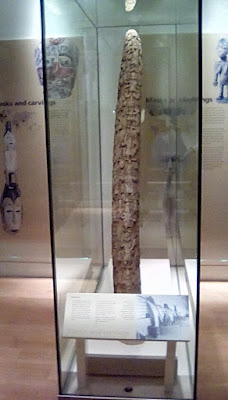

There's a lot of heartache behind the glass at a museum.
In the meantime I'm trying to find out more about this prince of Benin and the Kingdom of Warra. Sometimes people are better than Google, so I'm hoping to speak to a curator soon - and I'm really hoping I'll be able to get in touch with someone from that culture to hear their experiences and stories.
So, back to the Living Cultures gallery. This time I decided to watch some of those films. I'm one of those people that never watches films in galleries. Partly this is impatience - I like to experience things in my own time, and partly because I spend enough of life staring at a screen - when I go to a museum I want to stare through glass at stuff.
Anyway, the films were well worth watching. I heard about a man stabbed through the heart by a thrown Sudanese spear after a property dispute, I learned about Kente cloth and Mohawk beadwork. I also heard the tale of a prince of Benin who travelled with his people and founded the Kingdom of Warri.
There's a wonderful carved Elephant tusk which was dedicated to a Benin ruler or Oba who was exiled by the British in 1897, just about the same time as this tusk was taken as it happens. Exile's a word that always brings a chill to my heart. I remember Mobray in Richard 2. "Now my tongue's use is to me no more than an unstringed viol or a harp.... What is they sentence then but speechless death, which robs my tongue from breathing native breath."


There's a lot of heartache behind the glass at a museum.
In the meantime I'm trying to find out more about this prince of Benin and the Kingdom of Warra. Sometimes people are better than Google, so I'm hoping to speak to a curator soon - and I'm really hoping I'll be able to get in touch with someone from that culture to hear their experiences and stories.
Thursday, 11 February 2016
Week 5
It's been quite a week. Dominic Berry came to see me at the museum on Friday. Dominic's a talented and experienced writer of poetry for children and I've asked him to mentor me on this project. You should check out his webpage. Earlier in the week we'd both been to see http://louisethepoet.co.uk/'s show The Sleepover at Z Arts. It was great. Lots of chewy rhymes, physical theatre and humour. It really got me thinking.

Especially I started to think about making Hermes the star of the show. I started off thinking of making a big Hermes doll complete with gold sandals, winged helmet, staff and before I knew what was happening I was online shopping for gold sandals for me. I think I'm going to be Hermes. (Dominic's quite excited by the whole gender switching thing as well as the vegan carrot cake in the cafe!).
Dominic's encouraged me to stick to four key poems within the Hermes narrative. I was all set to write twelve, and I still might, but only 4 will be central to the show. The others can be imported if required. We thought they should represent a journey in time. I was already keen on writing about the meteoroite (Oooh, yes, I bought a meteorite from ebay. It's only as large as my thumb nail but I keep touching it and thinking "That's come from outer space!" and "That might be older than the earth!") and the tree frog. The tree frog's interesting because not only is it that strange transition between land and see (and Hermes loves those boundaries) but because there's another story, about how we've impacted the world around us without even thinking about it (Palm oil, folks!).
We talked about also having a human story - just yet I'm not sure what that is, and also a story of a future. I checked in my notebook and noticed that according to Aesop (who argues with Aesop!) Hermes was the ruler of the gate of prophetic dreams which fits beautifully.
We also went down to the dinosaurs to have a look round. Dominic's working on a work for children around Dinosaurs. I thought he should have a land, air and water dinosaur, but it turns out the air and water reptiles aren't actually dinosaurs. Which is a shame because they're cool. Actually it was mostly nautilus that charmed me. Guess I'm going to have to write about nautilus myself!
So we started to think about my poems in terms of the air (meteorite), water (frog) and land (human migration). I think the fourth might be fire. Have we a fiery future. I was talking to one of my pupils about the sun cooling into a red giant and the probability that the earth would get swallowed up. He told me that when his primary school teacher told his class about it, one little girl cried inconsolably. I don't want to have that effect on children. Personally I'm not all that bothered about what happens in 7 or 8 billion years. I guess Hermes might be though....

Friday, 29 January 2016
Week 4
So, today was the day an ipad nearly went through a glass case.... I've been experimenting with Frame Artist with a view to using it for workshops. I've spent a morning chasing text boxes that disappeared and saved templates that were never to be found. I almost never lose patience with people but sometimes I wish apps were sentient so I could hurt them!
But I've also been drafting a couple of poems - one about the parade of souls at the breakfast table and another about Hermes. He's the god of travellers and traders, the god who crosses borders and boundaries. In my mind's eye I imagine him hanging out at Calais and among the refugees of Iraq and Syria. I don't know how much help he'll be - he's not a straightforward god. He's inventive but he's also a trickster. He's mercurial - literally, he later became the Roman god Pan. Perhaps he's Loki too. I've even come across a suggestion in my research that his modern incarnation is Wily Coyote.
I like him. He makes more sense to me than most of the gods I come across. I guess I'm ok with a god that plays dice!
While researching I also discovered a poem written about him by H.D., and it's wonderful (damn!).
But I've also been drafting a couple of poems - one about the parade of souls at the breakfast table and another about Hermes. He's the god of travellers and traders, the god who crosses borders and boundaries. In my mind's eye I imagine him hanging out at Calais and among the refugees of Iraq and Syria. I don't know how much help he'll be - he's not a straightforward god. He's inventive but he's also a trickster. He's mercurial - literally, he later became the Roman god Pan. Perhaps he's Loki too. I've even come across a suggestion in my research that his modern incarnation is Wily Coyote.
I like him. He makes more sense to me than most of the gods I come across. I guess I'm ok with a god that plays dice!
While researching I also discovered a poem written about him by H.D., and it's wonderful (damn!).
| Hermes of the Ways |
| By H. D. |
Sunday, 24 January 2016
Week 3
First things first. Cardamom buns! The museum cafe is back open and serving cardamom buns. These are new to me - they're made of a bread dough, the colour of brown sugar, flavoured with cardomom and I suspect cinnamon and served warm and they're absolutely delicious.


While I ate my bun and waited for Debbie and Cat I sketched this out. My drawing skills aren't all that great - but I wanted a visual way of expressing something I'd been sensing more and more - that our feelings about migration and about the interaction within the human world and between the human and natural world are strongly linked to how we view the connectedness of the world.

While we were discussing this and the idea that in early human societies the need to trade and exchange must have formed much of the basis for migration - and also that none of us have what we need. Solely we can achieve very little - the greater our ambition, the greater our need to co-operate. Cat wondered if we could mimic that in a word game where children had to trade cards to get the words they would need to create sentences. It reminded me a bit of 'Fish', a game we used to play as children, or 'Old Maid' without the maid (and obviously I like positive messages about single middle-aged women these days!).
Sitting there eating my bun (I told you the bun was important) and drinking coffee I thought about how even our breakfast involves the contribution of a whole parade of souls - including the cow. There's a poem there!
Debbie also handed over a special camera for me to try. It's a Polaroid camera except it prints out stickers. We talked about how we might use this in a workshop based around the questions I used last week to write the poemlets. We also talked about using the ipods for the same job - so I get to test out an ipod (I'm an android user) and practice using Frame Artist.
Then I went back up to the money gallery - a gallery I hadn't previously realised existed. I came to it through the live reptiles and frogs, which has always been the end point of my visits. I went back to have another look at this.

This is a contract on papyrus from Egypt in the 1st century BC. It's an artist's contract committing to perform at a number of festivals in return for a set fee. I've got a drawer full of these - though none of them on papyrus.

I also spotted him. He's Hermes, the God of traders and travellers. I thought I might write a poem about him too.
When I started this project faced with the two themes of Water and Migration I was tempted to spend most time on water because the subject of Migration is so fraught. But it occurs to me that if it's place in it's historical, global and natural context it becomes less so. I spoke to Tania from Sustain Education about this and she agrees that maybe school's would be helped by having a way into those discussions. It's very topical. And there is, I think, a moral imperative. They're tricky things, both in poetry and in education, so it needs to be handled carefully.
I went back through to see the tree frogs. I thought about the evolution of fish, amphibia and reptiles and about how that movement from sea to land is a kind of migration. Nearly every textbook talks about 'conquering' the land. That's weird when you think of it. I started to think about the language that was used - invasion, colonisation, exploration - for more or less the same thing. Could I use these in the card game. Dare I give these words scores - using the highest for the most or the least manipulative?
Back through Nature's Library, I started to notice things (particularly plants and invertebrates) named after other things. This is a kind of migration of ideas, which I suppose is what a metaphor is. Could a writing exercise be based on naming? Here are some of them - I love that there's a chocolate chip starfish!


Sunday, 17 January 2016
Week 2
This week I met Debbie the Primary Co-ordinator in the Education Department at Manchester Museum and had a chat about the project. Debbie's going to be working with me for the next few weeks. One of the things we talked about was how our perceptions of things shifted depending on what we brought to the experience. In this way a museum was like a work of art. Debbie also wondered if we could use music to influence a child's experience of a museum.
The first job was to go round the 12 key objects I chose last week and answer my own questions, which you might remember from last week were;
Here they are:
 Maharajah: walked 200 miles from Edinburgh to Belle Vue zoo in 1872
Look at my huge feet, how easily they carry my weight.
It was a long way. It has been a long time.
 Spice Racks: India 1865, wood
I have treasures. I have secrets.
Spin me fast enough and my pods pop off, fizz like stars.
 Bark Cloth: made of beaten Masi stems, stencilled, Fiji, before 1942
Roll me out. I will hold your nights and your days, your lives and your children.
I will whisper to you in my patterns, sing the wind in the Masi.
 Chinese Dish, Porcelain and enamel, decorated with bats and long life symbols, for export
Sprinkle me with leaves, lay me with fruit.
I am yellow like the sun. I came across the miles. I was always here.
 Helmet: metal, Iran, donated 1946
I was Persia, the Orient, Asia Minor.
I was war, death, dignity, defence.
 Head-dress: Manchu, China, Kingfisher feather, bamboo, silk, more than 60 years old.
I know your greatness. I will make you great in the eyes of the world.
I am pain - the kingfisher, the oyster, the silkworm, the hands that cut. Did you think it could be otherwise?
 Iron Core of Meteorite: Campo del Cielo (Field of Heaven) Argentina, 16th Century.
I am alien. I am earth.
We are all spacedust.
 Jaw: Hammerhead Shark
It was only ever hunger, life.
When there were nerves, this mouth knew the whole world which spewed into it.
 Cabinet of Tiny Fossils: 19th Century Collection
I am the deep history of the earth. Collected, ordered, classified.
The earth resists this project. It flirts with chaos, comes back to us giggling with surprises.
 Plaster Cast of Dog buried in Ash: Vesuvious, Italy
I am every dog, scratching his back. I didn't see it coming.
I might have followed you, begged for scraps, licked your face. I have smelly breath.
 Green Tree Python: Modified muscles, prehensile tail, climbs trees, sleeps during the day, head tucked in the middle of its coils, bites, Australian rain forest.
This is my tree. I have not moved all week.
I am more threatened than threatening. Let me sleep.
 Fragments of Pottery: Archaeological interpretation and analysis.
Each one of us was part of something, a jar, a dish, a cup.
Our mismatched fragments become a new whole.
 Frog and duck weights: Mesopotamia, 2-3rd Millenia BC
The balance, the baking, the baggies. I am your history too.
How might it be not to apportion - mass, time, value, love?
I realised I had not given much thought to the themes of water and migration during this. So I've picked two ideas to think about this week - trade and poisoned and polluted water.
The first job was to go round the 12 key objects I chose last week and answer my own questions, which you might remember from last week were;
- What do we say about the object?
- What does the object say about itself?
- What does it really mean?
Here they are:

Look at my huge feet, how easily they carry my weight.
It was a long way. It has been a long time.

I have treasures. I have secrets.
Spin me fast enough and my pods pop off, fizz like stars.

Roll me out. I will hold your nights and your days, your lives and your children.
I will whisper to you in my patterns, sing the wind in the Masi.

Sprinkle me with leaves, lay me with fruit.
I am yellow like the sun. I came across the miles. I was always here.

I was Persia, the Orient, Asia Minor.
I was war, death, dignity, defence.

I know your greatness. I will make you great in the eyes of the world.
I am pain - the kingfisher, the oyster, the silkworm, the hands that cut. Did you think it could be otherwise?

I am alien. I am earth.
We are all spacedust.

It was only ever hunger, life.
When there were nerves, this mouth knew the whole world which spewed into it.

I am the deep history of the earth. Collected, ordered, classified.
The earth resists this project. It flirts with chaos, comes back to us giggling with surprises.

I am every dog, scratching his back. I didn't see it coming.
I might have followed you, begged for scraps, licked your face. I have smelly breath.

This is my tree. I have not moved all week.
I am more threatened than threatening. Let me sleep.

Each one of us was part of something, a jar, a dish, a cup.
Our mismatched fragments become a new whole.

The balance, the baking, the baggies. I am your history too.
How might it be not to apportion - mass, time, value, love?
I realised I had not given much thought to the themes of water and migration during this. So I've picked two ideas to think about this week - trade and poisoned and polluted water.
Week 1
Cat and I met for a chat at the museum - we both got quite excited about the possibilities. One of Cat's suggestions was to look for key objects so I took my tablet round the museum and took 12 photos. I didn't think too much about it. I just took things that made me react in some way or another.
After my journey round the museum I felt quite overwhelmed and went for a walk. I thought about whether children could take ipods round and take pictures and then organise their pictures into groups, like their own personal galleries. 2 groups of 6, 3 groups of 4, 4 groups of 3 (wasn't it lucky I chose the number 12!). What would connect the items in their groups? Could you have 6 pairs of opposites.
Then I started thinking about something Cat had said about the need to keep looking again at objects that had become familiar in order to see something more in them - and about how we wanted to encourage children to do that in a limited amount of time.
I came up with 3 questions:


After my journey round the museum I felt quite overwhelmed and went for a walk. I thought about whether children could take ipods round and take pictures and then organise their pictures into groups, like their own personal galleries. 2 groups of 6, 3 groups of 4, 4 groups of 3 (wasn't it lucky I chose the number 12!). What would connect the items in their groups? Could you have 6 pairs of opposites.
Then I started thinking about something Cat had said about the need to keep looking again at objects that had become familiar in order to see something more in them - and about how we wanted to encourage children to do that in a limited amount of time.
I came up with 3 questions:
- What do we say about the object?
- What does the object say about itself?
- What does it really mean?
I wasn't really sure if those questions would get us anywhere but it felt like a good start!
Here are those images. More about them next week.


Subscribe to:
Posts (Atom)